By Nora Thorne // IoT Architect & Smart Home Systems Specialist
The Problem: You Can’t Run Neutral Where Neutral Never Existed
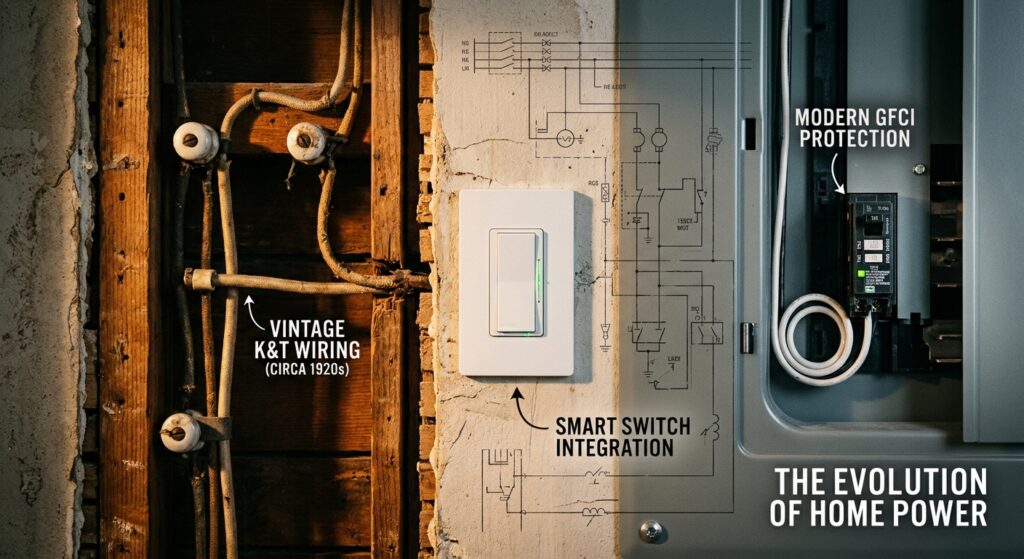
Knob-and-tube (K&T), multi-wire branch circuits (MWBC) on shared neutrals, and switch loops in 1920s–1950s homes present the same fundamental constraint: there is no neutral at the switch box, and running one is either structurally destructive, code-prohibited, or cost-prohibitive.
| Wiring Type | Era | Neutral at Switch? | Typical Switch Loop | Code Status |
|---|---|---|---|---|
| Knob-and-Tube | 1880s–1940s | Never — hot and neutral run separately | Single hot down to switch, switched hot back | “Grandfathered” but uninsurable in many jurisdictions |
| Early NM (Romex) | 1930s–1960s | Sometimes — 2-wire + ground, no neutral at switch | Switch loop with hot + switched hot | Legal if originally permitted |
| MWBC (Shared Neutral) | 1950s–1980s | At one leg only — two hots share one neutral | 3-wire cable to box, but neutral belongs to other circuit | Legal if handle-tied breakers; dangerous if not |
| Conduit (EMT/BX) | 1920s–present | Possible to pull — but often full | Pull box access varies | Legal, but labor-intensive |
The no-neutral smart switch was invented for exactly these scenarios. But legacy wiring introduces constraints that a standard bypass capacitor and fixture-box wiring don’t fully address.
Constraint 1: Knob-and-Tube Has No Ground
K&T wiring predates equipment grounding conductors. The “ground” terminal on a modern smart switch has nowhere to land.
K&T Typical Switch Loop:
  Hot (black cloth) ──────────────┬──── Switch L
                                   │
  Switched Hot (black cloth) ──────┼──── Switch L1/OUT → Fixture
                                   │
  Neutral (white cloth) ───────────────────────→ Fixture (separate path)
                                   │
  Ground ──────────────────────────────────────✗  DOES NOT EXIST
Grounding Strategy for K&T Switch Boxes
| Approach | Code Basis | Pros | Cons |
|---|---|---|---|
| GFCI Breaker + No Ground at Switch | NEC 404.2(C) exception, 250.130(C) | Legal, protects entire circuit | No ground reference for switch chassis |
| GFCI Receptacle at First Outlet + Ground to Box | NEC 250.130(C)(1) | Establishes ground path downstream | Requires accessible first outlet |
| Grounding to Metal BX/Conduit Armor | NEC 250.118(5)–(7) | Uses existing armor as EGC | Only if armor is continuous to panel |
| Run Dedicated Equipment Ground (Green) to Panel | NEC 250.130(C) | Full code compliance | Invasive — fishing through plaster/lath |
Recommendation for Smart Switch Installs on K&T:
- Install a GFCI breaker on the circuit (handles ground-fault protection for the whole run)
- Use a plastic switch box or a listed non-metallic smart switch (e.g., Shelly 1L, Leviton DN6HD) that doesn’t require a ground connection for its listing
- Bond the fixture ground to the metal fixture body (required by 410.16)
- Do not bootleg ground to neutral — creates parallel neutral current on the K&T neutral, a fire hazard
NEC 404.2(C) Exception: “Where a switch controls a lighting load and the grounded circuit conductor is not present in the switch box, a neutral shall not be required.” This is the statutory basis for no-neutral switches on K&T.
Constraint 2: MWBC — The Shared Neutral Trap
An MWBC feeds two 120 V circuits (A and B) on opposite legs with a single shared neutral. If you put a no-neutral smart switch on one leg, its leakage current returns on the shared neutral, creating imbalance.
MWBC Panel View:
  Leg A (Black) ───────┬── Circuit 1 (e.g., Kitchen Lights)
                        │
  Leg B (Red) ──────────┼── Circuit 2 (e.g., Dining Lights)
                        │
  Shared Neutral (White) └── Returns current for BOTH circuits
The Leakage Current Problem on MWBC
A no-neutral switch on Circuit 1 leaks ~1–2 mA through its load. That current returns on the shared neutral. Meanwhile, Circuit 2 may have zero load. The neutral now carries 1–2 mA unbalanced current — not a safety issue, but:
- AFCI/GFCI breakers may nuisance-trip (they detect neutral-ground leakage >5 mA)
- Neutral current adds up if multiple no-neutral switches share the MWBC neutral
- Lost neutral scenario: If the shared neutral opens, both legs go to 240 V across loads — catastrophic for electronics
MWBC Smart Switch Rules
| Rule | Reason |
|---|---|
| Handle-tied breakers mandatory | NEC 210.4(B) — prevents single-leg trip leaving neutral live |
| One no-neutral switch per MWBC max | Limits cumulative leakage on shared neutral |
| GFCI breaker preferred over receptacle | Protects both legs + neutral; MWBC GFCI breakers exist (2-pole GFCI) |
| Never put no-neutral switches on both legs | Doubles leakage; AFCI/GFCI will trip |
| Label the panel: “MWBC — Shared Neutral — Max 1 No-Neutral Switch” | Future electrician protection |
2-Pole GFCI Breaker Wiring for MWBC
Panel:
  Leg A ────────┬──── GFCI 2-Pole Breaker ───┬──── Circuit 1 Hot (Black)
                │                              │
  Leg B ────────┼──── (Handle Tied) ──────────┼──── Circuit 2 Hot (Red)
                │                              │
  Neutral ──────┴──── GFCI Neutral Pigtail ────┴──── Shared Neutral (White)
                │
  Ground ─────────────────────────────────────────→ Ground Bar
2-Pole GFCI Breaker Options (120/240 V, 15/20 A):
- Eaton BRGF220 / CHGF220 — 2-pole 20 A GFCI, ~$95
- Siemens QF220A / QF215A — 2-pole GFCI, ~$85
- Square D HOM220GFI / HOM215GFI — Homeline 2-pole GFCI, ~$110
Critical: A 2-pole GFCI does not require a neutral connection to the breaker for 120 V loads — the breaker’s internal electronics are powered line-to-line. But the shared neutral must land on the breaker’s neutral lug (pigtail) for the GFCI sensing to work.
Constraint 3: No Ground + No Neutral = Battery Switch + Fixture Relay
When you have neither neutral nor ground at the switch box (K&T in a plastic box, or early NM with no EGC), a no-neutral smart switch can work — but only if:
- The switch is battery-powered (no leakage current through load)
- The switching action happens at the fixture via a relay module
- The relay module has neutral and ground at the fixture
Architecture: Battery Switch + Fixture Relay
Switch Box (Plastic, No Neutral, No Ground):
  ┌─────────────────────────────────────┐
  │  Battery Switch (e.g., Lutron Pico, │
  │  Inovelli Battery Dimmer,           │
  │  Hue Dimmer, Caséta Pico)           │
  │  • No wires to mains                │
  │  • RF (Clear Connect, Z-Wave,       │
  │    Zigbee, Matter/Thread)           │
  │  • 10-year coin cell (CR2477)       │
  └──────────────┬──────────────────────┘
                 │ RF / Thread / BLE
                 ▼
Fixture Box (Has Neutral + Ground):
  ┌─────────────────────────────────────┐
  │  Fixture Relay Module               │
  │  • Line + Neutral + Ground from     │
  │    circuit                          │
  │  • Load to fixture                  │
  │  • RF Receiver (paired to switch)   │
  │  • Examples:                        │
  │    - Lutron Caséta PD-10NXD (plug-in│
  │      lamp module, but can be        │
  │      hardwired in J-box)            │
  │    - Aeotec Nano Switch ZW116       │
  │      (in fixture box, with neutral) │
  │    - Shelly 1 / 1PM (in fixture)    │
  │    - SONOFF ZBMINI-L2 (in fixture)  │
  └─────────────────────────────────────┘
Battery Switch Options Comparison
| Switch | Protocol | Battery Life | Relay Pairing | Best For |
|---|---|---|---|---|
| Lutron Pico (Caséta) | Clear Connect (433 MHz) | 10 yr (CR2477) | Caséta PD-10NXD, PD-6WCL, RA2 | Whole-home Lutron |
| Inovelli Battery Dimmer (Blue/Red Series) | Z-Wave 800 / Zigbee | 2–3 yr (CR2477) | Any Z-Wave/Zigbee relay | Z-Wave/Zigbee mesh |
| Hue Smart Dimmer | Zigbee (Hue) | 3 yr (CR2477) | Hue Smart Plug / Hue Relay | Hue ecosystem |
| Caséta Pico (RA2 Select) | Clear Connect Type X | 10 yr (CR2477) | RA2 Select dimmers | RA2 Select |
| Leviton Decora Smart (Wi-Fi) Battery | Wi-Fi / Matter | 1 yr (AA) | Leviton D23LP / D26HD | Wi-Fi/Matter |
| Third Reality / Moes Battery Switch | Zigbee / Thread | 2 yr (CR2477) | Any Zigbee/Thread relay | Budget Thread |
Fixture Relay Module Options (Require Neutral + Ground at Fixture)
| Module | Protocol | Form Factor | Max Load | Notes |
|---|---|---|---|---|
| Aeotec Nano Switch ZW116 | Z-Wave | In-box (47 mm) | 15 A / 1800 W | Needs neutral; smallest Z-Wave relay |
| Shelly 1 / 1PM (Gen 3) | Wi-Fi / MQTT / Matter | In-box (43 mm) | 16 A / 1800 W | PM = power metering; Matter via bridge |
| SONOFF ZBMINI-L2 | Zigbee 3.0 | In-box (40 mm) | 10 A / 1200 W | External antenna option; binding groups |
| Lutron Caséta Plug-In Dimmer PD-3PCL | Clear Connect | Plug-in (hardwireable) | 300 W LED | Can be hardwired in 4×4 J-box at fixture |
| Inovelli Blue 2-in-1 (Z-Wave) | Z-Wave | In-box | 15 A | Switch + relay in one; needs neutral |
| Third Reality / Sonoff Mini R4 (Thread) | Matter/Thread | In-box | 10 A | Thread border router required |
Wiring: Battery Switch + Fixture Relay (K&T Example)
CIRCUIT BREAKER PANEL
  │
  ├─ Hot (Black K&T) ─────────────────────────────────────────┐
  │                                                           │
  ├─ Neutral (White K&T) ─────────────────────────────────────┤
  │                                                           ▼
  │                                                    ┌──────────────┐
  │                                                    │ FIXTURE BOX  │
  │                                                    │ (Octagon,    │
  │                                                    │  Metal,      │
  │                                                    │  Grounded)   │
  │                                                    │              │
  │                                                    │  Hot ────────┼── L (Relay Module)
  │                                                    │              │
  │                                                    │  Neutral ────┼── N (Relay Module)
  │                                                    │              │
  │                                                    │  Ground ─────┼── GND (Relay + Fixture)
  │                                                    │              │
  │                                                    │  Load ───────┼── Fixture Hot
  │                                                    │              │
  │                                                    │  Fixture ────┴── Fixture Neutral
  │                                                    │              │
  │                                                    │  Relay RF Antenna
  │                                                    └──────┬───────┘
  │                                                           │ RF
  │                                                           ▼
  │                                                    ┌──────────────┐
  │                                                    │ SWITCH BOX   │
  │                                                    │ (Plastic,    │
  │                                                    │  No Ground)  │
  │                                                    │              │
  │                                                    │  Battery     │
  │                                                    │  Switch      │
  │                                                    │  (Pico,      │
  │                                                    │  Inovelli,   │
  │                                                    │  etc.)       │
  │                                                    │  • No wires  │
  │                                                    │  • Surface   │
  │                                                    │    mount or  │
  │                                                    │    in box    │
  │                                                    └──────────────┘
GFCI Strategy Decision Matrix
| Scenario | GFCI Approach | Breaker/Device | Why |
|---|---|---|---|
| K&T, no ground anywhere | GFCI Breaker (1-pole) | Eaton BRGF120 / Siemens QF120A / Square D HOM120GFI | Protects entire circuit; no ground needed |
| K&T, metal BX armor continuous to panel | Ground to Armor + GFCI Breaker | Same as above + armor as EGC | Armor provides ground path; GFCI backs it up |
| MWBC (shared neutral) | 2-Pole GFCI Breaker | Eaton BRGF220 / Siemens QF220A / Square D HOM220GFI | Protects both legs + shared neutral |
| Early NM, ground at fixture only | GFCI Receptacle at First Outlet | Leviton GFTR1-W / Hubbell GFRST15W | Establishes ground downstream; cheaper than breaker |
| Battery Switch + Fixture Relay | GFCI Breaker on Circuit | 1-pole or 2-pole per above | Relay has neutral/ground; switch is wireless |
| Finished Basement / Bathroom on K&T | GFCI Breaker + AFCI | Dual-Function (CAFCI/GFCI) Eaton BRCAF120GF / Siemens QF120AF | NEC 210.12 + 210.8 — both required |
GFCI Breaker Quick Specs (120 V, 15/20 A)
| Brand | 1-Pole 15 A | 1-Pole 20 A | 2-Pole 15 A | 2-Pole 20 A | Dual-Function (CAFCI+GFCI) |
|---|---|---|---|---|---|
| Eaton BR | BRGF115 ($45) | BRGF120 ($45) | BRGF215 ($95) | BRGF220 ($95) | BRCAF115GF ($65) / BRCAF120GF ($65) |
| Eaton CH | CHGF115 ($55) | CHGF120 ($55) | CHGF215 ($110) | CHGF220 ($110) | CHCAF115GF ($75) / CHCAF120GF ($75) |
| Siemens QP | QF115A ($40) | QF120A ($40) | QF215A ($85) | QF220A ($85) | QF115AF ($60) / QF120AF ($60) |
| Square D Homeline | HOM115GFI ($50) | HOM120GFI ($50) | HOM215GFI ($110) | HOM220GFI ($110) | HOM115CAFIC ($70) / HOM120CAFIC ($70) |
| Square D QO | QO115GFI ($65) | QO120GFI ($65) | QO215GFI ($130) | QO220GFI ($130) | QO115CAFIC ($85) / QO120CAFIC ($85) |
Panel Compatibility: Match breaker series to panel (BR/CH → Eaton BR/CH loadcenter; QP → Siemens/Murray; HOM → Homeline; QO → QO). Do not cross-brand.
The AHJ Conversation Guide: “It’s Grandfathered, Not Illegal”
You will face pushback. Here’s how to navigate it professionally.
What the AHJ Sees vs. What the Code Says
| AHJ Concern | Code Reality | Your Response |
|---|---|---|
| “No ground at switch = illegal” | NEC 404.2(C) Exception: neutral not required; 250.130(C) permits GFCI protection in lieu of EGC for existing circuits | “The circuit is GFCI-protected at the breaker per 210.8(A). The switch is listed for no-neutral/no-ground use (UL 60730). Grounding is provided at the fixture per 410.16.” |
| “Battery switch isn’t a ‘switch'” | NEC 404.2 — “switch” definition includes any device that opens/closes a circuit; battery switch + relay is the switching means | “The switching function is performed by the listed relay module at the fixture (UL 508/UL 60730). The battery device is a remote actuator — same as a 3-way traveler pair, just wireless.” |
| “MWBC with smart switch = neutral imbalance” | NEC 210.4(B) requires handle ties; 2-pole GFCI monitors neutral current | “2-pole GFCI breaker installed with handle ties. Leakage current <2 mA per switch, well below 5 mA GFCI threshold. Panel labeled per 110.22.” |
| “K&T can’t be extended/modified” | NEC 394.10 — K&T extensions require modern wiring; replacements of devices are permitted | “No new K&T installed. Existing circuit unchanged. Device replacement per 404.2(C) exception. GFCI breaker added per 210.8.” |
| “Wireless = unreliable for life safety” | NEC doesn’t regulate control reliability for lighting; UL 60730 covers wireless actuators | “Relay module is hardwired at fixture. Wireless link is control only — loss of signal = light stays in last state (fail-safe). No different from a broken 3-way traveler.” |
Documents to Bring to the Permit Office
- Single-line diagram showing: Panel → GFCI Breaker → Circuit → Fixture Relay → Fixture; Battery Switch location noted as “Wireless Actuator (No Mains Connection)”
- Cut sheets for: GFCI breaker, Fixture Relay Module (UL listing), Battery Switch (UL 60730 / FCC ID)
- NEC References Printed: 404.2(C) Exception, 210.8(A), 210.4(B), 250.130(C), 394.10, 410.16
- Manufacturer Installation Instructions for the specific no-neutral/battery switch + relay pairing
- Load Calculation showing total circuit load ≤ 80% breaker rating (per 210.23)
Script for the Counter Conversation
You: “I’m replacing a toggle switch on a grandfathered K&T circuit with a listed no-neutral smart switch system. The circuit gets a 20 A GFCI breaker [show breaker cut sheet]. The switch is battery-powered — no mains connection — and controls a UL-listed relay module at the fixture box [show relay cut sheet], which has neutral and ground. The fixture ground bonds to the metal box per 410.16. The GFCI breaker provides ground-fault protection for the entire circuit per 210.8 and 250.130(C). No new wiring is being fished — this is a device replacement on an existing circuit. May I pull the permit?”
Complete Decision Flowchart: K&T / MWBC / No-Ground Scenarios
START: Smart switch needed on legacy circuit (K&T, early NM, MWBC)
│
├─► Is there NEUTRAL at switch box?
│     ├─ YES → Standard smart switch (not this article)
│     └─ NO (no neutral)
│           │
│           ├─► Is there GROUND at switch box (metal BX, conduit, or EGC)?
│           │     ├─ YES → No-neutral smart switch + bypass at fixture (Article 8)
│           │     │     ├─ MWBC? → 2-Pole GFCI Breaker + Handle Ties + Max 1 Switch
│           │     │     └─ Not MWBC? → 1-Pole GFCI Breaker
│           │     │
│           │     └─ NO (no ground either — plastic box, K&T, early NM)
│           │           │
│           │           ├─► Can you run ground to panel? (250.130(C))
│           │           │     ├─ YES → Run ground + no-neutral switch + GFCI Breaker
│           │           │     └─ NO → Battery Switch + Fixture Relay (below)
│           │           │
│           │           └─► BATTERY SWITCH + FIXTURE RELAY PATH
│           │                 │
│           │                 ├─► Fixture box has NEUTRAL + GROUND?
│           │                 │     ├─ YES → Proceed
│           │                 │     └─ NO → Run neutral+ground to fixture (or abandon)
│           │                 │
│           │                 ├─► Choose Protocol (match ecosystem):
│           │                 │     ├─ Lutron → Pico + Caséta Relay (PD-10NXD hardwired)
│           │                 │     ├─ Z-Wave → Inovelli Battery + Aeotec Nano Switch ZW116
│           │                 │     ├─ Zigbee → Hue Dimmer / Third Reality + SONOFF ZBMINI-L2
│           │                 │     ├─ Matter/Thread → Moes/Third Reality + Thread Relay
│           │                 │     └─ Wi-Fi → Leviton Battery + Shelly 1 in fixture
│           │                 │
│           │                 ├─► GFCI Breaker on Circuit (1-pole or 2-pole for MWBC)
│           │                 │
│           │                 ├─► Label Panel: "GFCI Protected — Wireless Actuator at Switch — Relay at Fixture"
│           │                 │
│           │                 └─► Permit with Single-Line + Cut Sheets + NEC References
│           │
│           └─► MWBC Special Case:
│                 ├─► 2-Pole GFCI Breaker MANDATORY
│                 ├─► Handle Ties MANDATORY
│                 ├─► Max ONE no-neutral switch per MWBC
│                 ├─► If battery switch + relay: relay on ONE leg only
│                 └─► Panel Label: "MWBC — Shared Neutral — 2-Pole GFCI — Max 1 Wireless Actuator"
Real-World Example: 1920s Foursquare, K&T Lighting Circuit
House: 1924 Foursquare, original K&T lighting circuits, plaster walls, no conduit.
Circuit: Bedroom 2 lighting — K&T, 15 A fuse (now breaker), no ground anywhere.
Goal: Smart dimming for LED retrofit (4 × 9 W filament LEDs = 36 W).
Solution Implemented
| Component | Model | Location | Cost |
|---|---|---|---|
| GFCI Breaker | Eaton BRGF120 | Panel (replaced 15 A breaker) | $45 |
| Battery Dimmer | Lutron Pico PJ2-3BRL-GWH-L01 | Switch box (surface mount) | $22 |
| Fixture Relay | Lutron Caséta PD-10NXD (hardwired in 4×4 J-box at fixture) | Ceiling fixture box | $48 |
| Bypass Capacitor | Lutron LUT-BYP-1 (22 µF) | At fixture, parallel with load | $15 |
| Total | $130 |
Wiring at Fixture (4×4 J-box above ceiling)
K&T Hot ────────────────────────────────────────────┬──── L (PD-10NXD)
                                                     │
K&T Neutral ────────────────────────────────────────┼──── N (PD-10NXD)
                                                     │
K&T Ground (none) → BX Armor not present → GFCI Breaker provides protection
                                                     │
Bypass Cap (LUT-BYP-1) ─────────────────────────────⊕⊘──── Across Load Terminals
                                                     │
Load ───────────────────────────────────────────────┼──── Load (PD-10NXD) → LED Fixtures
                                                     │
Ground ─────────────────────────────────────────────┴──── Fixture Grounds + Metal Box
AHJ Interaction
- Permit pulled: “Device Replacement — Lighting Control” ($65)
- Inspector question: “Where’s the ground at the switch?”
- Response: “GFCI breaker at panel per 210.8/250.130(C). Switch is battery-powered wireless actuator (no mains). Relay at fixture has neutral from K&T. Fixture grounded to metal box per 410.16. Bypass capacitor listed.”
- Result: Passed. Inspector noted “GFCI protection substitutes for EGC on existing circuit” on ticket.
What Not to Do (Common Mistakes)
| Mistake | Why It Fails | Code Violation |
|---|---|---|
| Bootleg ground (neutral → ground at switch) | Creates parallel neutral current on K&T; energizes switch chassis if neutral opens | 250.142(B), 404.2(C) |
| No-neutral switch on MWBC without 2-pole GFCI | Shared neutral carries leakage; AFCI/GFCI trips; lost neutral = 240 V on loads | 210.4(B), 210.8 |
| Battery switch + relay on both legs of MWBC | Doubles neutral leakage; 2-pole GFCI sees imbalance | 210.4(B) |
| Relay module in switch box (no neutral there) | Relay needs neutral — defeats purpose | 404.2(C) |
| Using DC electrolytic capacitor as bypass | Explodes on AC; fire hazard | 110.3(B), 300.15 |
| Skipping GFCI on K&T “because it’s grandfathered” | Grandfathering doesn’t exempt 210.8 GFCI requirements for replacements | 210.8(A), 404.2(C) |
| Multiple no-neutral switches on one K&T circuit | Cumulative leakage > switch minimum load; all drop out | 404.2(C), mfr specs |
Quick Reference Card: Legacy Circuit Smart Switch Cheat Sheet
| Circuit Type | Neutral at Switch? | Ground at Switch? | Solution | GFCI Required | Max Switches |
|---|---|---|---|---|---|
| K&T | No | No | Battery Switch + Fixture Relay | 1-Pole GFCI Breaker | 1 per circuit |
| K&T + Metal Armor | No | Yes (armor) | No-Neutral Switch + Bypass | 1-Pole GFCI Breaker | 1 per circuit |
| Early NM (2-wire) | No | Sometimes | No-Neutral Switch + Bypass | 1-Pole GFCI Breaker | 1 per circuit |
| MWBC (Shared Neutral) | One Leg Only | Yes | No-Neutral Switch (1 leg) + 2-Pole GFCI | 2-Pole GFCI Breaker | 1 total |
| Conduit (Pullable) | No | Yes (conduit) | Pull Neutral → Standard Switch | Standard Breaker | N/A |
Series Scheduling
- Publish Date: 2026-11-06 (Thursday)
- Publish Time: 10:00 AM EST (America/New_York)
- Slug:
knob-tube-mwbc-out-of-code-gfci-battery-switches - Categories: Smart Switches, Wiring & Installation, Electrical Code, Retrofit
- Tags: no-neutral, knob-and-tube, mwbc, gfci, battery-switch, fixture-relay, ahj, nec, retrofit
- Author: Nora Thorne
- Site: myhomeio.com
What’s Next in the Series
Article 10/10: Retrofit Project: 1920s Foursquare Whole-House Conversion — Cost Breakdown & Lessons Learned (Sunday 10 AM EST) — The capstone case study tying all 9 articles together with real numbers, photos, and the “what I’d do differently” list.
End of Article 9/10 — Knob-and-Tube, MWBC, and Other “Out of Code” Circuits — GFCI Strategy & Battery Switches.